Choosing a toaster oven for a small kitchen requires balancing compact dimensions with the ability to handle various cooking tasks. The best models use their internal volume efficiently, often including convection or air fry features, which circulate hot air to cook food more evenly and quickly than traditional radiant heating alone.
Some links in this post are affiliate links. If you buy through them we may earn a small commission at no extra cost to you — it never changes which products we recommend.
A less capable toaster oven tends to have uneven heat distribution because it lacks a convection fan or uses less powerful heating elements, resulting in hotspots that burn some areas while leaving others undercooked. Size alone does not guarantee good cooking results; understanding the oven’s heating mechanism, control precision, and interior layout separates a useful compact model from one that ends up underused.
What actually matters
Evaluating toaster ovens for small kitchens goes beyond exterior size. The internal capacity must suit your typical meals without wasting countertop space. Features like convection fans or specialized heating elements affect cooking speed and consistency. Controls and preset functions influence ease of use and final food quality.
The heating mechanism is critical to performance. Traditional radiant heating elements emit infrared heat directly onto food, but without air circulation, heat zones develop. This can cause uneven cooking, especially in dense or larger items. The addition of a convection fan, which circulates hot air at speeds of 100 to 300 cubic feet per minute, helps maintain a uniform temperature throughout the chamber. This airflow accelerates heat transfer, reducing cooking times by approximately 20-30% compared to radiant-only ovens.
Air fry functions build on convection by combining rapid air movement with high heat (often 400-450°F) and sometimes infrared elements. This technology creates a Maillard reaction on food surfaces, producing crisp textures similar to deep frying but with up to 90% less oil. Power consumption for these ovens typically ranges from 1500 to 1750 watts, balancing fast heat-up times with energy efficiency.
Size and layout also play a big role. Compact ovens measuring around 18 to 20 inches in width and 10 to 14 inches in depth can accommodate standard pans like 9×13 inches or pizzas up to 12 inches. The interior design should optimize airflow; racks placed too close to heating elements or walls can obstruct circulation, causing uneven cooking. Multiple rack positions and included accessories like crumb trays and baking pans enhance versatility and ease of cleaning.
Control precision directly affects cooking outcomes. Digital interfaces with temperature increments as fine as 5°F and multiple presets simplify complex cooking processes and reduce user error. Mechanical knobs, while sometimes less precise, offer durability and straightforward operation. Safety features such as cool-touch doors and stay-on timers are especially valuable in small kitchens where space constraints increase the risk of accidental contact or unattended cooking.
In summary, the ideal toaster oven for small kitchens integrates efficient heating mechanisms with a well-thought-out interior and user-friendly controls, ensuring consistent and versatile cooking performance without wasting precious countertop space.
Heating mechanisms and airflow
Traditional toaster ovens rely on radiant heating elements located at the top and bottom, which heat food through direct infrared radiation. Without a fan to circulate air, heat distribution depends heavily on the placement of the food and the oven’s internal geometry. Convection toaster ovens add a fan that circulates hot air at about 200 to 450°F (93 to 232°C), reducing cooking times by up to 30% and promoting more even browning by preventing hot or cold spots.
Air frying toaster ovens use rapid hot air circulation at high speeds, often combined with infrared heating, to mimic deep frying with a crisp finish but using up to 90% less oil. The effectiveness depends on maintaining airflow paths unobstructed and sufficient power, typically around 1500 to 1750 watts.
Size, capacity, and interior layout
Small kitchens demand appliances that maximize usable internal volume without consuming excessive counter space. Ovens with dimensions around 18 to 20 inches wide and 10 to 14 inches deep fit comfortably in limited spaces yet can hold standard pan sizes like 9-by-13 inches or a 12-inch pizza.
Interior accessories such as multiple rack positions, baking pans, and crumb trays affect versatility and cleanup. Some models include rotisserie kits or specialized air fry baskets. The layout should allow hot air to circulate freely around the food to ensure uniform cooking.
Control precision and usability
Precise temperature control, from approximately 150 to 450°F (65 to 232°C), allows for consistent cooking across different recipes. Digital controls with presets simplify common tasks like baking, broiling, or air frying, while mechanical knobs typically require more attention but can be more durable.
Features like stay-on timers, clear LCD displays, and cool-touch doors improve safety and convenience, especially in small kitchens where multitasking is common. Easy-to-clean interiors with non-stick coatings or enamel finishes reduce maintenance time.
How to choose the right toaster oven for a small kitchen
Start by measuring your available counter space and deciding how much cooking volume you need. If you regularly cook for multiple people or want to bake larger items like 12-inch pizzas or 4-pound chickens, opt for models offering a minimum of 26 quarts interior capacity. Consider whether you want multiple cooking functions such as air frying, dehydrating, or rotisserie, which add versatility but can increase complexity and price.
If your kitchen is extremely tight on space, a flip-up model like the Ninja Flip can help reclaim countertop area when not in use. However, these often come with trade-offs in capacity and cost. Convection is a key feature for consistent results; avoid models that rely solely on radiant heat unless your cooking needs are minimal. Lastly, think about how much time you want to spend cleaning; non-stick interiors and removable crumb trays simplify maintenance in daily use.
Beyond space and features, consider power consumption and noise levels. Most toaster ovens designed for small kitchens operate between 1200 and 1750 watts. Higher wattage models heat faster and maintain temperature more steadily but may increase electricity use and generate more heat in your kitchen environment. Noise from convection fans varies by model; quieter fans typically operate below 50 decibels, roughly the sound of a quiet office, while louder units can reach 60 decibels or more, which might be distracting in open-plan living spaces.
Durability and warranty coverage are also important. Look for brands offering at least one year of warranty on parts and labor. Stainless steel exteriors and interiors with enamel or non-stick coatings tend to resist staining and corrosion better than plastic components, extending the appliance’s lifespan.
Finally, user reviews and expert tests can provide insight into real-world performance and reliability. Pay attention to feedback on temperature accuracy, ease of cleaning, and longevity of digital controls or mechanical parts. These factors affect satisfaction and value over time.
| Pick | Best for | Capacity or Key Feature | Watch out for |
|---|---|---|---|
| TOSHIBA ChefFry 26.4QT | Air frying versatility | 26.4 quarts, 12-in-1 functions | Slightly larger footprint for very tight spaces |
| TOSHIBA ChefFry 34QT | Pizza and family meals | 34 quarts, dual-temp pizza mode | Higher power use, larger size |
| BLACK+DECKER TO3250XSBD | Extra-wide capacity | 8 slices, 60-minute timer | Basic controls, no air fry |
| BLACK+DECKER Crisp ‘N Bake Pro | Air frying with max space | Fits 9×13 pans, digital presets | Limited to 6 slices toast max |
| TOSHIBA 10-in-1 Convection | Family-size convection baking | Fits 6 slices, 12-inch pizza | Convection fan noise could be noticeable |
| Ninja Flip SP151 | Space-saving flip design | Fits 6 slices, flips up for storage | Premium price, niche design |
From my kitchen
Once, I tried roasting a small chicken in a toaster oven without convection, expecting similar results to my full-size oven. The skin ended up unevenly browned, with the underside soggy due to stagnant air and uneven heat. Switching to a convection toaster oven with a fan made a noticeable difference; the circulating air removed moisture from the skin and distributed heat evenly, producing a crisp, golden bird in less time. This episode reinforced how important airflow and fan power are to the cooking outcome, especially in compact ovens.
Worth Considering
Best for air frying versatility: TOSHIBA ChefFry Air Fryer Toaster Oven Combo, 26.4-Quart

This model offers 12 cooking functions including air fry and dehydrate, using 450°F air circulation for crispy results with less oil. It suits users who want multiple cooking options in one compact unit but is a bit larger than the smallest models, which might crowd very limited counter space.
Brand: TOSHIBA · Price when checked: $159.99 · Rating: 4.2 out of 5 (100 ratings)
Pros
- Multi-functionality with 12 cooking modes
- Non-stick interior for easy cleaning
- Air fry technology reduces oil use
Cons
- Interior size may be too large for very small kitchens
- No digital controls; interface might be less intuitive
Best for pizza and larger family meals: TOSHIBA ChefFry Air Fryer Toaster Oven Combo, 34QT
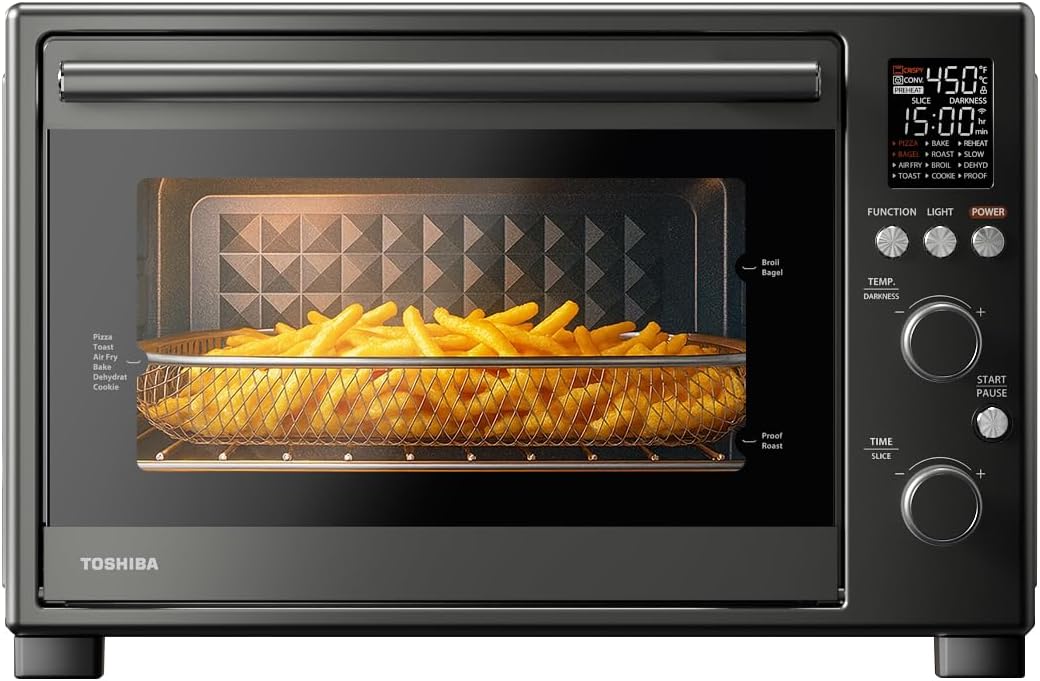
Designed with a dual-temperature pizza mode that crisps crust and caramelizes toppings separately, this 34-quart oven suits households prioritizing pizza and shared meals. Its larger capacity and 1750W power make it less ideal for small kitchen counters where space is at a premium.
Brand: TOSHIBA · Price when checked: $179.97 · Rating: 4.0 out of 5 (451 ratings)
Pros
- Dual-temp technology for better pizza cooking
- Cool-touch dual-layer door enhances safety
- Scratch-resistant enamel interior
Cons
- Largest footprint in this list
- Higher energy consumption
Best for extra-wide baking tasks: BLACK+DECKER TO3250XSBD 8-Slice Extra Wide Convection Toaster Oven

This convection toaster oven has an extra-wide interior that fits up to 8 slices of bread and includes flexible rack positions. It lacks air fry capability and digital presets but is a straightforward, budget-friendly choice for those who want more baking space without extra features.
Brand: 4.3 4.3 out of 5 stars · Price when checked: $86.87 · Rating: 4.2 out of 5 (1,793 ratings)
Pros
- Large capacity in a compact shape
- 60-minute timer with stay-on option
- Multiple rack positions
Cons
- No air fry or advanced cooking modes
- Manual controls without presets
Best for air frying with max usable space: BLACK+DECKER Crisp ‘N Bake Pro 6-Slice Digital Air Fry Oven

This oven uses high-intensity circulating air to air fry with little to no oil and fits standard 9×13-inch pans despite its small footprint. It has 10 digital presets making it easy to use, but the 6-slice toast capacity may feel limited for some families.
Brand: 4.5 4.5 out of 5 stars · Price when checked: $76.49 · Rating: 4.2 out of 5 (6,931 ratings)
Pros
- Air fry technology with minimal oil
- Fits large baking pans in compact size
- Digital controls with multiple presets
Cons
- Limited to 6 slices of toast max
- Digital controls can be prone to wear over time
Best for family-size convection baking: TOSHIBA 10-in-1 Convection Toaster Oven, 6-Slice

With 1500W convection heating and adjustable temperature up to 450°F, this oven handles up to 6 slices of toast or a 12-inch pizza. It includes useful accessories like a rotisserie kit, but the fan noise can be noticeable during operation, which may bother some users in quiet kitchens.
Brand: TOSHIBA · Price when checked: $119.99 · Rating: 4.2 out of 5 (137 ratings)
Pros
- Powerful convection fan for even cooking
- Spacious interior with accessories
- Clear, intuitive knob controls
Cons
- Convection fan noise can be intrusive
- Footprint slightly larger than some compact models
Best for saving counter space: Ninja Flip Toaster Oven & Air Fryer, SP151
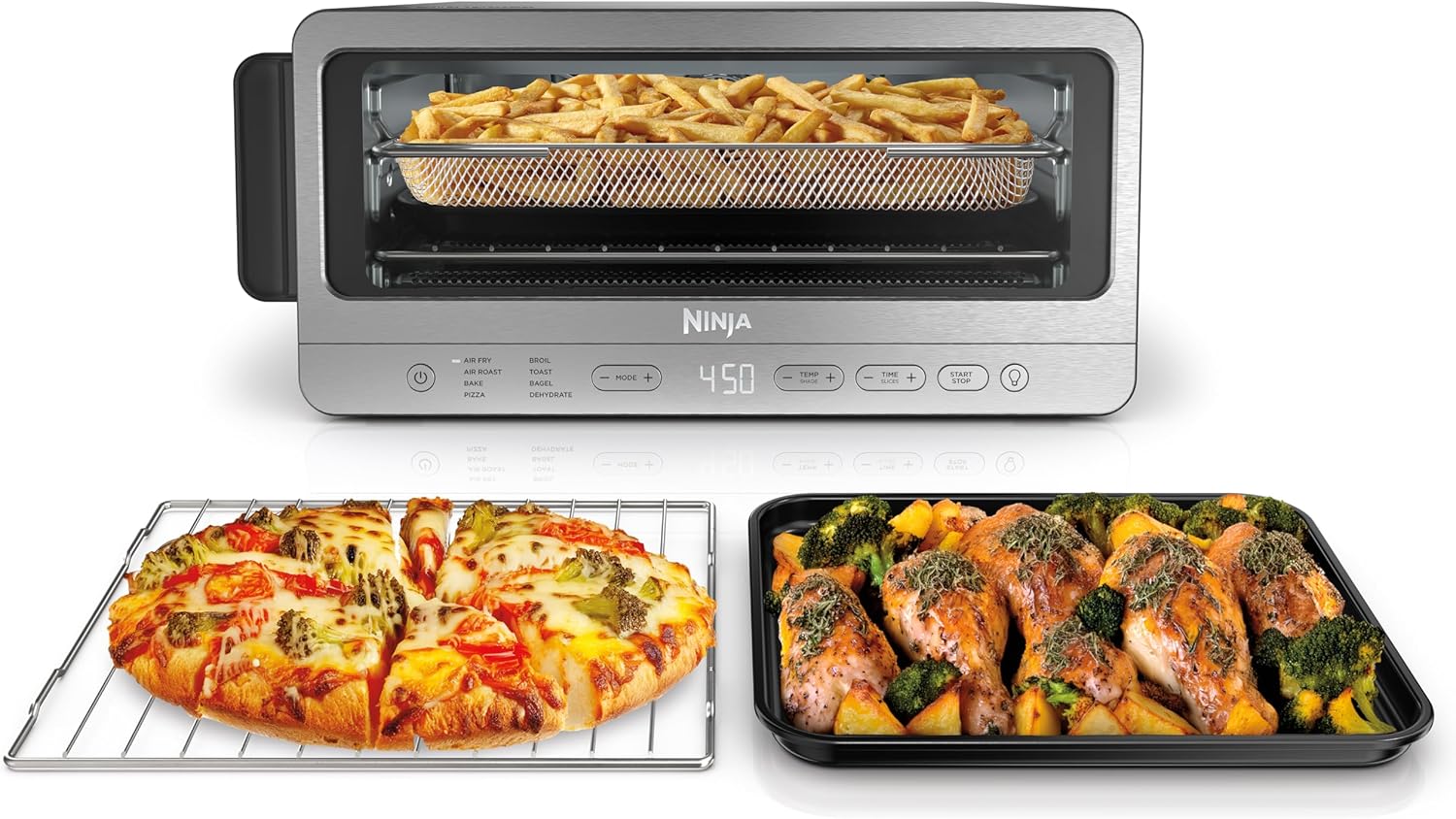
Its unique flip-up design folds the oven vertically against the backsplash, reducing counter footprint by 50%. It combines infrared and rapid air circulation for consistent cooking. This niche design suits kitchens where counter space is extremely limited but comes at a premium price and with a smaller interior volume.
Brand: 4.4 4.4 out of 5 stars · Price when checked: $246.99 · Rating: 4.2 out of 5 (356 ratings)
Pros
- Innovative flip-away design saves space
- Infrared plus air fry technology for even cooking
- Fits family-sized meals in a compact footprint
Cons
- Higher price point
- Smaller capacity than some standard models
Related reading
- 7 Best Air Fryer Toaster Oven Combos for 2026
- Grill basket vs grill mat: practical differences for better BBQ cooking
- Top 10 air fryers for a small kitchen with compact designs and practical features
Frequently Asked Questions
Why is convection important in a toaster oven for small kitchens?
Convection uses a fan to circulate hot air around the food, promoting even cooking and browning. In small toaster ovens, where heating elements are close to the food, convection prevents hotspots and undercooked areas by maintaining consistent temperature distribution. This reduces cooking times by up to 30% compared to ovens without fans, making it especially useful when space limits cooking size.
Can a toaster oven replace a full-size oven for everyday cooking?
A toaster oven can handle many cooking tasks like toasting, baking, broiling, and air frying, but its smaller interior limits the size and quantity of food cooked at once. For small households or simple meals, it can replace a full-size oven effectively. However, for large roasts or baking multiple dishes simultaneously, a conventional oven remains more practical.
What features should I prioritise for easy cleaning in a toaster oven?
Look for models with non-stick or enamel-coated interiors that resist grease and food buildup, making wiping down simple. Removable crumb trays are essential to catch debris and prevent buildup in hard-to-reach corners. Accessories such as dishwasher-safe racks and pans also reduce cleaning effort. Avoid models with complicated interiors where crumbs can hide and require scrubbing.

Rimi Sultana is a home cook from Bangladesh who has cooked for her family every day for the past five years and writes about it at Smart Cooks. Perpetually testing whether internet-famous recipes actually work in a regular home kitchen. Say hello on Facebook or through the contact page.