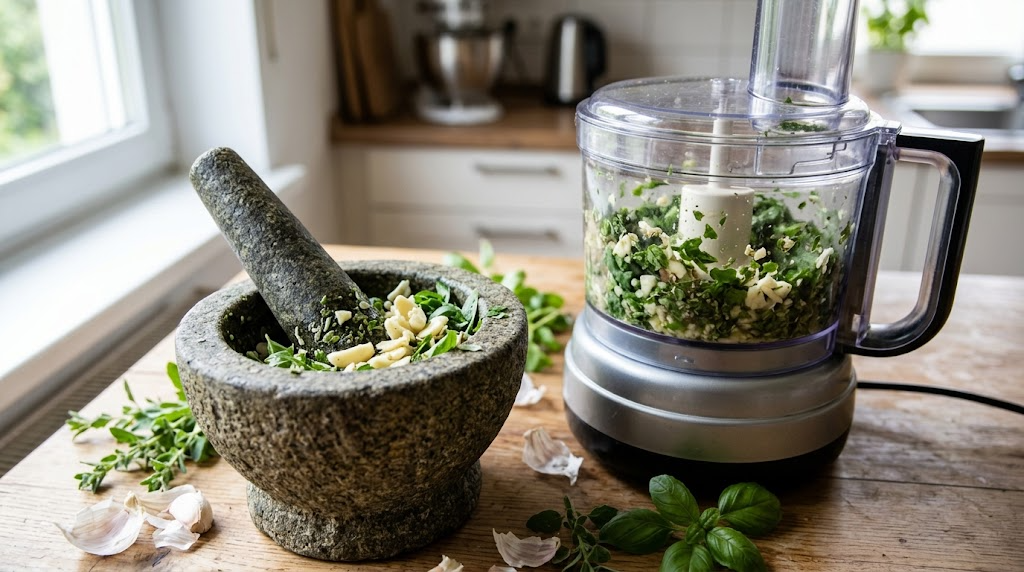
For pastes and sauces built on aromatics — pesto, chimichurri, curry pastes, garlic-based sauces — the tool you crush them with genuinely changes the final result, not just the time it takes to get there.
Some links in this post are affiliate links. If you buy through them we may earn a small commission at no extra cost to you — it never changes which products we recommend.
What Each One Actually Does
Mortar and Pestle
Crushing releases oils and juices from herbs, garlic, and spices through pressure and grinding rather than the fast shearing action of blades. This produces a rougher, more textured paste with more released aromatic oil, since the cell walls are broken open more gradually rather than sliced through.
Food Processor
Blades cut through ingredients quickly, which is far faster and less physical effort, especially for larger batches. But the fast cutting action can introduce more air and heat into the mixture, and doesn’t release oils from herbs and aromatics quite as thoroughly as crushing does.
Where Each One Actually Wins
- Mortar and pestle wins on flavor depth for small-batch pastes where you’re specifically after maximum aromatic release — classic pesto and many curry pastes are traditionally made this way for a reason.
- Food processor wins on speed and volume — if you’re making a big batch of sauce for meal prep or a crowd, grinding it all by hand isn’t realistic.
- Mortar and pestle wins on texture control — you can stop at a coarse, rustic texture more easily than most food processors allow.
- Food processor wins on convenience for everyday cooking — most people aren’t going to hand-crush garlic for a weeknight pasta sauce, and that’s a reasonable trade-off.
From My Kitchen: The Pesto That Convinced Me the Difference Is Real
I made the same basil pesto recipe two ways on the same day, once in a food processor and once by hand in a granite mortar and pestle, specifically to see if the difference people describe was real or overstated. The hand-crushed version was noticeably more aromatic and had a brighter, more vivid basil flavor — the food processor version tasted slightly duller and more oxidized, likely from the faster blade action bruising and heating the basil more than the slow crushing did. That said, the food processor version was ready in under a minute, and the mortar and pestle took nearly fifteen. For a special dinner, I’d crush it by hand again. For a Tuesday, the food processor wins easily.
Worth Considering
ChefSofi’s granite mortar and pestle set is a solid, well-weighted option if you want to try the traditional approach for small-batch sauces.
Ninja’s 9-cup food processor handles larger sauce batches quickly without sacrificing much control over texture.
Why the Same Ingredients Taste Different
A food processor cuts. Spinning blades slice through cell walls at speed, and the cell contents are released as juice which then mixes with everything else. A mortar and pestle crushes. The pressure ruptures cells and grinds the solids into each other, which releases oils rather than just juice and creates an emulsion between the oil and the water already present. That is why a pesto made in a mortar looks and tastes different from one made in a processor even with identical ingredients.
There is also a heat difference that matters more than people expect. A processor’s blade spinning at speed warms the mixture slightly, and warm basil oxidises — which is exactly why processor pesto often turns a duller, browner green within minutes while the mortar version stays vivid. For herbs and delicate aromatics, that is a genuine quality difference, not a romantic preference.
Quick Comparison
| Mortar and pestle | Food processor | |
|---|---|---|
| Texture | Rustic, emulsified, varied | Uniform, sometimes watery |
| Oil release from herbs and spices | High — crushing releases oils | Lower — cutting releases juice |
| Heat added | None | Slight, enough to dull herbs |
| Quantity | Small, a cup or so | Large batches easily |
| Effort | Real physical work | Push a button |
| Cleaning | Rinse and dry | Bowl, lid, blade |
When Each One Is the Right Choice
Use the mortar for anything where aromatic oils are the point: pesto, spice pastes, garlic and chilli pastes, gremolata, and toasted whole spices. Bengali and South Asian cooking is full of pastes that behave noticeably differently ground on a stone than blitzed — the texture clings to food rather than sliding off it, and the flavour is rounder because the oils have been worked into the paste rather than left in fragments.
Use the processor when quantity or time is the constraint, or when the recipe is not built on aromatics — a large batch of tomato sauce, a hummus, a chopped nut mixture. There is no shame in the processor for these; blitzing chickpeas in a mortar is an afternoon’s work for no flavour gain. Many cooks use both in one recipe: spices ground in the mortar, then added to the bulk processed in the machine.
Two Tools Worth Considering
Best for pastes and spices: ChefSofi Granite Mortar and Pestle Set
Granite has the weight and the slightly rough interior that makes grinding efficient — a polished bowl lets ingredients slide instead of being crushed. Heavy enough that it stays put on the counter while you work, which is the main practical requirement.
Pros
- Rough granite surface grips and grinds efficiently
- Heavy enough to stay put while you work
- Handles both wet pastes and dry spices
Cons
- Needs seasoning with rice before first use
- Very heavy to lift and store
Best for volume: Ninja 9-Cup Food Processor
For large batches of sauce, chopped vegetables and anything where the aromatic subtlety of a mortar is not the point, the processor does in thirty seconds what would take half an hour by hand.
Pros
- Handles large batches quickly
- Consistent results with no technique
- Useful well beyond sauces
Cons
- Warms delicate herbs slightly
- More parts to wash than a mortar
Frequently Asked Questions
Does a mortar and pestle really make a noticeable flavor difference?
For aromatic, herb- and garlic-forward sauces, many people can taste a real difference, largely because of how much more oil gets released through crushing versus fast blade-cutting. For sauces that are simmered or cooked afterward, the difference matters less.
What size mortar and pestle should I buy?
A 1.5 to 2 cup capacity handles most standard sauce recipes without needing to work in multiple batches, while staying manageable to store.
Can a food processor replace a mortar and pestle entirely?
For most everyday cooking, yes — the convenience trade-off is worth it for most people. It’s really only for specific traditional recipes or when maximum flavor extraction matters most that the difference becomes worth the extra effort.
Do I need to season a new granite mortar?
Yes, and it is worth doing properly. Grind a few tablespoons of uncooked rice to a fine powder, discard it, and repeat until the powder comes out white rather than grey. The grey is stone dust from the manufacturing process, and skipping this means the first few things you grind will carry grit. Three or four rounds is usually enough, followed by a rinse with water and no soap.
Why does my processor pesto turn watery and dull?
Two causes with the same root. Cutting releases water from the basil rather than crushing oil out of it, so the mixture separates into a watery layer and an oily one instead of emulsifying. And the slight heat from the blade oxidises the basil, which dulls the colour within minutes. Pulsing rather than running continuously helps with both, as does adding the oil at the end by hand rather than blitzing it in.

Rimi Sultana is a home cook from Bangladesh who has cooked for her family every day for the past five years and writes about it at Smart Cooks. Perpetually testing whether internet-famous recipes actually work in a regular home kitchen. Say hello on Facebook or through the contact page.