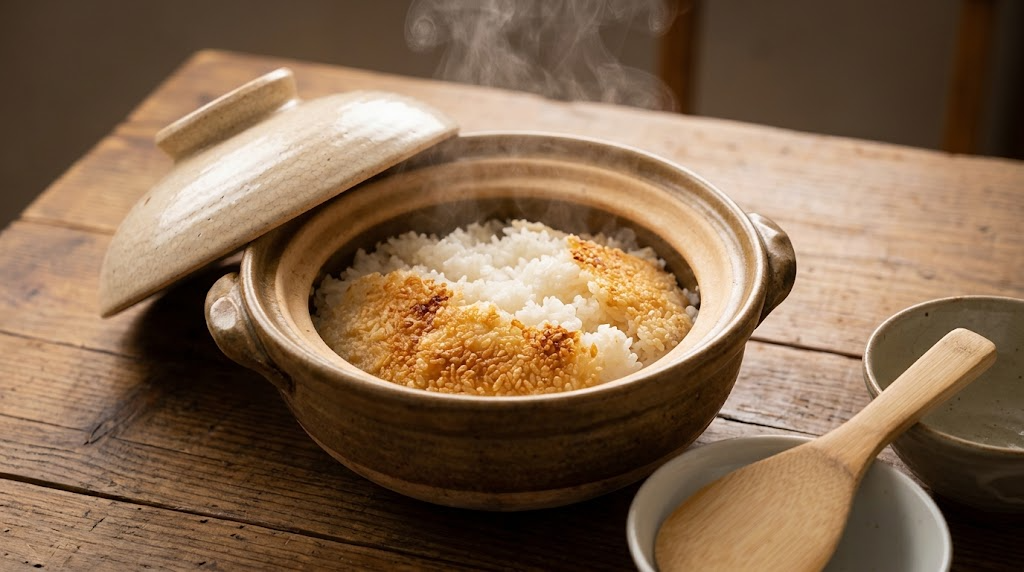
Ask a Japanese home cook why they keep a donabe when a machine rice cooker sits on the same counter, and the answer is usually one word: okoge — the pale gold, faintly chestnutty crust that forms on the bottom of clay-pot rice and that no machine will ever produce, because machines are engineered specifically to prevent it.
Some links in this post are affiliate links. If you buy through them we may earn a small commission at no extra cost to you — it never changes which products we recommend.
A donabe is Japan’s answer to the same instinct behind Mexico’s cazuela: thick, porous clay that heats slowly, holds heat stubbornly, and cooks food with a gentleness metal cannot fake. Rice comes out distinctly plump and sweet; winter hot pots (nabemono) simmer at the table in the same vessel they are served from. It is cookware and serveware and, frankly, furniture — a good donabe gets handed down.
The catch is the same as all clay: it demands specific care, hates thermal shock, and will not work on induction. We wrote about those trade-offs for Mexican clay in our cazuela guide; the physics travel. Here are seven donabe worth buying, split by their two jobs — rice and hot pot.
Our Top 7 Picks for the Best Donabe
Best Overall for Rice: Banko Ware Double-Lid Donabe Rice Cooker

Banko-yaki — the pottery tradition of Yokkaichi, Japan — is the source of most serious rice donabe, and the double lid is its signature engineering. An inner lid sits below the outer one, regulating pressure and catching starch so the pot neither boils over nor vents its moisture; the result is rice with the plump, glossy, individually distinct grains that donabe evangelists will not stop describing.
The method is famously forgiving once learned: medium heat until it steams, a set number of minutes, then off the heat to rest — no peeking, no stirring. The clay’s retained heat finishes the job and builds the okoge.
Key Specifications
- Banko-yaki earthenware from Japan
- Double-lid pressure-and-starch control
- Purpose-built for rice
- Stove-to-table serving
Pros
- The double lid genuinely prevents boil-overs
- Produces the plump-grain rice donabe are famous for
- Retained heat finishes cooking off the flame
- Authentic Japanese production
Cons
- Rice-first shape — not the hot pot choice
- Needs curing and clay-pot care
- No induction, like all clay
Best Small: DONABE Clay Rice Pot, 1 to 2 Cups, Made in Japan

Donabe rice scales badly downward in big pots — a thin layer of rice in a wide vessel dries before it plumps — so a genuinely small made-in-Japan pot for one or two cups is not a compromise, it is the correct tool for singles and couples.
This is also the cheapest way to find out whether clay-pot rice earns its counter space in your kitchen, using rice you were cooking anyway.
Key Specifications
- 1 to 2 cup rice capacity
- Made in Japan
- Classic donabe form
- Right-sized for one or two people
Pros
- Correct scale for small households
- Low-cost entry into donabe rice
- Doubles as a small serving pot
- Authentic production
Cons
- Too small for guests
- Small clay pots boil over faster — watch the first runs
- Same clay care rules apply
Best Family Size: DONABE Clay Rice Pot, 2 to 3 Cups, Made in Japan

The same made-in-Japan line one size up: two to three cups of raw rice, which in practice feeds a family of four with the leftovers that donabe rice makes weirdly desirable (cold okoge is a private household delicacy).
If you are choosing one rice donabe for a household, this is the size to choose — big enough for company, small enough that a weeknight two cups still sits deep enough in the pot to cook properly.
Key Specifications
- 2 to 3 cup rice capacity
- Made in Japan
- Family-of-four scale
- Classic glazed donabe
Pros
- The right single-pot size for most families
- Deep enough for proper weeknight batches
- Handsome on the table
- Authentic Japanese clay
Cons
- Bulky in a small cupboard
- Long cooldown before washing — clay rules
- Hand wash only
Best for Hot Pot: Japanese Donabe Ceramic Hot Pot Casserole

Nabemono — the whole family of Japanese table-top hot pots, from sukiyaki to yosenabe — wants a different shape than rice: wide and shallow, so everyone can reach in with chopsticks and the broth surface is generous. This is that pot, the classic wide donabe that goes from stove to a table burner and becomes the centre of the meal.
Wide clay also excels beyond Japan: it braises, it does a shallow biryani-style dum, it serves a bubbling stew with the heat retention of a small kiln. Winter equipment, honestly.
Key Specifications
- Wide, shallow hot-pot format
- Earthenware with fitted lid
- Stove-to-table-burner workflow
- Nabemono, sukiyaki, shabu setups
Pros
- The correct communal hot-pot geometry
- Holds serving heat through a long dinner
- Braises and stews beautifully too
- The social centrepiece format
Cons
- Wrong shape for serious rice
- Needs a table burner for the full experience
- Wide clay demands careful even preheating
Best Traditional Workhorse: Sanko Banko Ware Deep Pot No. 8, Black Glaze

The No. 8 deep pot in black glaze is what an actual Japanese household most likely owns: an unglamorous, deep, do-everything Banko donabe that cooks rice acceptably, hot pots properly, and stews magnificently, in the traditional wire-crest black finish that hides a decade of use.
Deep-format donabe are the utility players — if you want exactly one clay pot to cover rice, nabe and braises without specialising in any, this shape is the honest answer.
Key Specifications
- Banko ware, made in Japan
- No. 8 deep multi-purpose format
- Traditional black glaze
- Rice, nabe and braise capable
Pros
- One pot covers all three donabe jobs
- Traditional household standard
- Black glaze wears invisibly
- Generous depth for stews
Cons
- Master of none versus the specialists
- No double lid for rice
- Heavy when full
Best Gift: Banko-Yaki Donabe with Cherry Blossom Design

A donabe is one of the rare pieces of cookware that works as a genuinely good gift, because it is beautiful before it is ever used — and this cherry-blossom Banko piece is built to be seen. Same authentic Yokkaichi earthenware underneath; the decoration rides on top of a real tool, not instead of one.
For a wedding, a housewarming, or the friend who just discovered hot pot restaurants, this is the version that gets unwrapped to an actual gasp.
Key Specifications
- Authentic Banko-yaki earthenware
- Cherry blossom decorated exterior
- Functional hot pot and stew donabe
- Gift-appropriate presentation
Pros
- Beautiful enough to gift or display
- Real Banko clay underneath the decoration
- Table-serving centrepiece
- Wide usable format
Cons
- Decoration costs a premium over plain
- Pattern wear with hard scrubbing
- Same clay limits: no induction, no shocks
Best Modern Rice Pot: Banko-Yaki Fluffy Rice Pot with Inner Lid and Measuring Cup

The modernised take on the double-lid rice donabe: inner lid, matched measuring cup, and water-level guidance designed so your first pot works without a translated technique video. It is Banko clay with the onboarding problem solved.
My rice cooker makes better everyday rice than my donabe does, and I would rather say that plainly before anything else — it is more consistent, it needs no watching, and on a weeknight it wins.
What the donabe gives you is the one thing a machine is specifically engineered to prevent: okoge, the thin crackling layer stuck to the bottom of the pot. The first time I got it right, I scraped it up with a wooden spoon and it was gone before the rest of the rice reached the table. So no, it did not replace my rice cooker. It replaced the idea that rice is a background dish.
Key Specifications
- Banko-yaki with inner lid
- Measuring cup and clear water guidance
- Beginner-calibrated instructions
- Made in Japan
Pros
- Easiest first success of the rice donabe
- Double-lid benefits with less guesswork
- Correct accessories in the box
- Authentic production
Cons
- Rice specialist, not a hot pot
- Costs more than the plain small pots
- Clay care still non-negotiable
The Ultimate Buying Guide for Donabe
Rice Donabe vs Hot Pot Donabe
The two jobs want opposite geometry. Rice wants a deep, narrow pot — ideally double-lidded — so steam pressure builds and grains cook in a tall, moist column. Nabemono wants wide and shallow, so the table can share it and ingredients poach in a broad broth. The deep “No. 8” style workhorses split the difference acceptably. Decide which dinner you are actually buying for; the wrong shape works, but grudgingly.
Why Clay Rice Is Different (It Is Not Mysticism)
Clay heats slowly and unevenly compared to metal — and for rice that is the feature. The long gentle climb gives amylases time to convert starches to sugars (measurably sweeter rice), the thick walls hold the boil steady without scorching, and the retained heat finishes cooking off the flame entirely. The okoge crust at the bottom is controlled, deliberate browning — the part machine cookers are programmed to refuse to make.
Curing and the Rules of Clay
A new donabe wants curing before first use — the classic method is cooking a pot of rice porridge (okayu) in it, which drives starch into the clay’s pores and seals them. After that, four rules keep it alive:
- Never heat it empty, and start on medium, not max
- No thermal shock — no cold water into a hot pot, no hot pot onto a cold wet counter
- Dry the unglazed base before every use — a wet foot over flame is the classic crack
- Air-dry fully before storing; a porous pot shut away damp grows musty
If you read our cazuela guide, this is the same physics with a Japanese accent. One meaningful difference: reputable Japanese donabe production — Banko, Iga and the other named traditions — has a strong food-safety track record on glazes; the buy-from-identified-makers rule still applies, and it is easy to follow here.
Your Stove Matters
Donabe are happiest on gas, where flame wraps the clay evenly. Electric coil works with gentle preheating. Glass smooth-tops need care — the unglazed foot can scratch, and slow even preheat is mandatory. Induction does not work at all; clay is not magnetic. (Some modern donabe embed a steel plate for induction — they exist, but they are the exception and are labelled loudly.)
Size Reference
- 1 to 2 cup rice pots — singles and couples
- 2 to 3 cups — the family default
- Wide 9 to 10 inch nabe — hot pot for three or four
- No. 8 to 9 deep pots — the one-pot-for-everything compromise
Frequently Asked Questions About Donabe
How do I cook rice in a donabe?
The standard method: rinse rice, soak 20 to 30 minutes in the pot with its measured water, lid on over medium heat until it reaches a strong steam (roughly 10 to 12 minutes), then 10 more minutes on low, then off the heat — untouched — for a 10 minute rest. No stirring, no peeking. The rest is not optional; the retained heat is doing the last third of the cooking.
What is the crust on the bottom — did I burn it?
If it is pale gold and smells toasty, that is okoge, and it is the prize — scrape it up and fight over it. Burnt is black and bitter and means the low-heat phase ran too hot or too long. The line between them is minutes, which is why donabe rice people are so specific about timing.
Why did my donabe crack?
Thermal shock, nearly always: a wet base over flame, cold liquid into a hot pot, max heat from a cold start, or a hot pot set on a cold surface. Hairline crazing in the glaze is normal and cosmetic; a through-crack that weeps is retirement. Slow heating and a dry foot prevent almost all of it.
Can I use a donabe on an electric or induction stove?
Electric coil and (carefully) smooth-top glass, yes, with patient preheating. Induction, no — clay does not couple with the magnetic field, and only specially built steel-plated donabe work there. On any electric stove, a heat diffuser smooths the hot spot and is cheap insurance.
Is a donabe worth it if I own a rice cooker?
They are different appliances in the same food group. The machine wins on convenience, timers and hands-off consistency — our Zojirushi vs Tiger comparison covers that world. The donabe wins on flavour ceiling, okoge, and doubling as the best hot-pot vessel you can own. Households that care about rice usually end up with both and use both.
How do I get smells out of a porous pot?
Simmer water with a spoonful of used green tea leaves or rice, or a splash of vinegar, for ten minutes; dry thoroughly in air. Avoid long detergent soaks — the pores that hold curry smell will hold lemon dish soap just as faithfully.
Final Thoughts
For rice, buy the Banko double-lid — sized 1-2 cups for a couple, 2-3 for a family — and give it the unpeeked twenty minutes it asks for. For winter tables, the wide hot-pot donabe is the most social piece of cookware money buys. And if it must be one pot, the deep No. 8 is the honest generalist.
Cure it with porridge, keep the foot dry, never rush the heat. Clay pays patience back with interest — in any language.
As an Amazon Associate we earn from qualifying purchases. Availability is accurate as of the date of publishing. We do not list prices because they change too often to quote honestly.
Related: Top 6 trivets for hot pots that protect surfaces and endure use

Rimi Sultana is a home cook from Bangladesh who has cooked for her family every day for the past five years and writes about it at Smart Cooks. Perpetually testing whether internet-famous recipes actually work in a regular home kitchen. Say hello on Facebook or through the contact page.