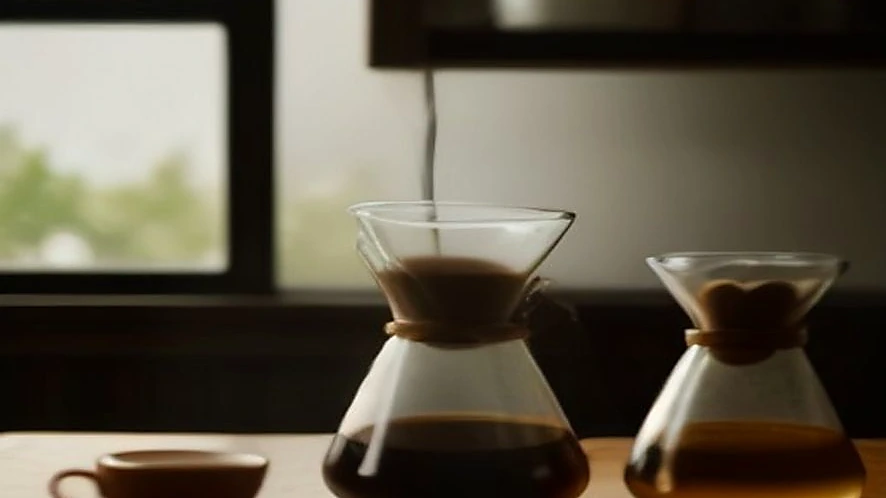
At first glance, a Chemex coffee maker looks like a type of pour over brewer, but they differ in several important ways that affect brewing control, extraction, and flavour. The defining elements are the shape of the brewer, the filter thickness and design, and how these influence water flow and contact time with the coffee grounds.
Some links in this post are affiliate links. If you buy through them we may earn a small commission at no extra cost to you — it never changes which products we recommend.
Many references group Chemex under the broad category of pour over coffee makers, but Chemex uses proprietary bonded paper filters that are roughly three times thicker than standard pour over filters. This alone changes the flow rate and extraction profile. Understanding these mechanisms helps clarify when a Chemex is preferable and when a simpler pour over device might be a better choice.
Where each one wins
The Chemex excels when you want a clean, delicate cup with minimal sediment and oils, thanks to its thick bonded filters. It’s especially useful for medium and light roasts where clarity of flavour and brightness are priorities. The glass carafe design also makes it suitable for serving multiple cups at once and for brewing larger volumes.
Typical pour over coffee makers shine in versatility and speed. Filters are thinner, so the brew time is shorter, and they are compatible with a wide range of filters and grind sizes. Their simpler design can be easier to clean and allows for more direct control over flow rate through pouring technique and grind adjustment. They also come in more compact sizes, ideal for single cups.
Delving deeper into the mechanics, the Chemex’s thick filters weigh about 20-30 g/m², compared to the 6-10 g/m² of standard filters. This thickness slows water flow substantially, increasing contact time with coffee grounds, which enhances extraction of delicate flavor compounds while filtering out oils and fines that contribute to bitterness and sediment. The hourglass-shaped glass carafe with a wooden collar not only retains heat effectively but also supports brewing larger volumes—up to 8 cups of 5 oz each (about 1.18 liters total)—making it ideal for group servings.
In contrast, typical pour over brewers, often made from ceramic, plastic, or stainless steel, have a cone-shaped dripper sitting atop a cup or server. Their thinner filters allow faster flow rates, reducing brew time and enabling quicker repeat brews or single-cup preparation. The faster flow rate, however, can lead to a cup with more body and oils, which some coffee drinkers prefer for a richer mouthfeel. The ability to adjust grind size and pouring technique gives users more control over extraction variables, but this requires more skill and attention.
Heat retention also varies: the Chemex’s borosilicate glass combined with the wooden collar helps maintain temperature during brewing, which is crucial for consistent extraction. Typical pour over brewers vary widely in heat retention depending on material, with ceramic retaining heat well, plastic less so, and stainless steel somewhere in between. This factor influences the stability of brewing temperature, which directly impacts flavor clarity and balance.
From my kitchen
Once, I tried brewing a darker roast in my Chemex and found the extraction felt underwhelming, muted compared to my usual pour over dripper. The thick filter slowed the flow too much, and the flavours seemed washed out. Switching back to a regular ceramic dripper with a standard filter restored the intensity and body I expected. This reminded me that the Chemex’s design favours lighter roasts and cleaner profiles, and isn’t always the right choice for every coffee or mood.
Quantitatively, the slower flow rate in Chemex can extend brew time by 30-60 seconds compared to typical pour over methods, which affects the extraction yield and total dissolved solids (TDS) in the final cup. For lighter roasts, this longer extraction helps highlight floral and fruity notes without over-extracting bitterness. However, for darker roasts with more soluble compounds, the prolonged contact can lead to muted flavors and less desirable extraction.
In practical terms, this means that if you prefer a quick morning brew or enjoy dark, full-bodied coffee, a standard pour over with thinner filters and faster flow might better suit your preferences. Conversely, if you value a bright, clean cup with clarity and are willing to invest more time in brewing, the Chemex is an excellent choice.
| Attribute | Chemex Pour-Over Glass Coffeemaker | Typical Pour Over Coffee Maker |
|---|---|---|
| Filter thickness | About 20-30 g/m² bonded paper filters | 6-10 g/m² standard paper filters |
| Material | Non-porous borosilicate glass | Usually ceramic, plastic, or stainless steel |
| Brew vessel shape | Hourglass-shaped glass carafe with wooden collar | Cone-shaped dripper sitting atop a cup or server |
| Flow rate | Slower due to thick filter and wide neck design | Faster, more variable depending on filter and grind |
| Heat retention | Good heat retention in glass body and collar | Varies; ceramic retains heat well, plastic less so |
| Capacity | 8 cups (5 oz per cup, about 40 oz / 1.18 L total) | Varies widely, typically 1-4 cups per brew |
From my kitchen
Once, I tried brewing a darker roast in my Chemex and found the extraction felt underwhelming, muted compared to my usual pour over dripper. The thick filter slowed the flow too much, and the flavours seemed washed out. Switching back to a regular ceramic dripper with a standard filter restored the intensity and body I expected. This reminded me that the Chemex’s design favours lighter roasts and cleaner profiles, and isn’t always the right choice for every coffee or mood.
Quantitatively, the slower flow rate in Chemex can extend brew time by 30-60 seconds compared to typical pour over methods, which affects the extraction yield and total dissolved solids (TDS) in the final cup. For lighter roasts, this longer extraction helps highlight floral and fruity notes without over-extracting bitterness. However, for darker roasts with more soluble compounds, the prolonged contact can lead to muted flavors and less desirable extraction.
In practical terms, this means that if you prefer a quick morning brew or enjoy dark, full-bodied coffee, a standard pour over with thinner filters and faster flow might better suit your preferences. Conversely, if you value a bright, clean cup with clarity and are willing to invest more time in brewing, the Chemex is an excellent choice.
Worth Considering
Best for clean, large-batch brewing: Chemex Pour-Over Glass Coffeemaker – Classic Series – 8-Cup

Ideal if you want a visually elegant brewer that makes bright, clean coffee with minimal sediment. The proprietary thick bonded filters and borosilicate glass vessel slow extraction and retain heat well. Not the best choice if you prefer quick brews or darker, heavier coffee.
Brand: Chemex · Price when checked: $48.95 · Rating: 4.8 out of 5 (2093 ratings)
Pros
- High-quality non-porous borosilicate glass that doesn’t retain odours
- Timeless hourglass design with wooden collar for safe handling
- Patented thick bonded filters reduce oils and fines in the cup
Cons
- Requires proprietary thicker filters, adding cost and less availability
- Longer brew times limit quick repeat brews or single-cup flexibility
When neither Chemex nor classic pour over is the right answer
For those who want full control over extraction variables like temperature, pressure, and timing, or prefer a richer, fuller-bodied coffee, neither the Chemex nor a classic pour over dripper may suffice. Alternatives like espresso machines, Aeropress, or siphon brewers allow for different extraction dynamics that suit darker roasts or milk-based drinks better. Additionally, if convenience and speed are priorities, drip coffee makers with automatic temperature control or single-serve pod machines may be more appropriate despite sacrificing some flavour nuance.
Related reading
- 9 Easy Homemade Drinks to Lose Weight Fast (Simple Recipes)
- AeroPress vs French Press for Daily Coffee: Which Brew Method Wins?
- Espresso machine vs moka pot: understanding real differences in brewing and taste
Frequently Asked Questions
Do Chemex filters affect the flavour compared to other pour over filters?
Yes. Chemex filters are significantly thicker and bonded, which slows water flow and reduces oils and fine coffee particles passing through. This results in a cleaner, brighter cup with less body compared to thinner standard paper filters commonly used in other pour over brewers.
Can I use regular pour over filters in a Chemex?
No. Chemex filters are designed specifically for its shape and thickness requirements. Regular thinner filters will not fit properly and will not provide the intended flow resistance, leading to faster extraction and different flavour profiles.
Which is easier to clean, Chemex or standard pour over dripper?
Standard pour over drippers made of ceramic or plastic generally clean more easily since they are simpler in shape and smaller. The Chemex’s glass carafe shape can be trickier to clean thoroughly without a brush designed for its curves, but it doesn’t absorb odours or stains thanks to the borosilicate glass.

Rimi Sultana is a home cook from Bangladesh who has cooked for her family every day for the past five years and writes about it at Smart Cooks. Perpetually testing whether internet-famous recipes actually work in a regular home kitchen. Say hello on Facebook or through the contact page.