A good drip coffee maker in your morning routine is about more than just brewing coffee. The key is how it manages water temperature and flow to saturate coffee grounds evenly, which controls extraction and flavour clarity. Machines that fail in these areas often produce sour or bitter coffee, revealing uneven brewing or temperature inconsistencies.
Some links in this post are affiliate links. If you buy through them we may earn a small commission at no extra cost to you — it never changes which products we recommend.
Features like build materials, programmability, and filter design influence ease of use and maintenance. For example, removable water tanks simplify refills, while thermal carafes retain heat longer, which matters if you sip slowly. The right drip coffee maker balances these factors to fit your specific morning cadence and coffee preferences.
What actually matters
Understanding the technical differences between drip coffee makers allows you to choose one that suits your brewing needs and kitchen setup without relying on marketing claims. The brewing process is a delicate balance of several factors that directly affect the final cup’s taste and aroma.
Temperature control and water distribution
Optimal extraction happens when water temperature stays between about 195°F and 205°F (90°C to 96°C). Coffee makers that use powerful heating elements and precise thermostats can maintain this range consistently. Maintaining this temperature range ensures that the coffee solubles are extracted properly: too low a temperature results in under-extraction with sour and weak flavours, while too high causes over-extraction, leading to bitterness and harshness.
Water distribution is managed via showerheads that spray water evenly over the coffee grounds. Designs like multi-hole or showerhead arrays help avoid channeling, where water flows unevenly and extracts poorly. Channeling can cause some grounds to be over-extracted while others remain under-extracted, resulting in an unbalanced cup. Some advanced machines employ pulse-brew or pulse-wetting techniques, which intermittently apply water to allow grounds to bloom and degas, further improving extraction uniformity.
In terms of mechanisms, heating elements rated around 1000-1500 watts provide rapid and consistent heating, while thermostats with tight tolerances (±1°C) help maintain stable temperatures throughout the brew cycle. Some models incorporate PID controllers for even finer temperature control, which is typically found in higher-end units.
Filter type and brew basket design
Flat-bottom baskets create a more uniform coffee bed, promoting even water flow compared to cone-shaped filters, which can cause uneven extraction unless ground size is carefully matched. The shape influences how water percolates through the grounds; flat-bottom designs encourage a wider and more consistent saturation area.
Permanent mesh filters reduce waste and maintain oils in the brew but require regular cleaning to avoid off-flavours. The mesh size typically ranges between 100 to 200 microns, balancing sediment retention with oil passage. If not cleaned properly, residual coffee oils can become rancid, negatively impacting flavour.
Paper filters remove oils and sediment but can absorb some flavour compounds, which may soften the coffee’s body and brightness. Some users prefer bleached or unbleached paper filters; the latter imparts a slight papery taste initially but is more environmentally friendly. The choice of filter affects not only taste but also maintenance and sustainability considerations.
Programmability and capacity
Programmable delay timers let you start brewing at a set time, useful for busy mornings. This feature allows you to wake up to freshly brewed coffee without manual intervention. Brew strength options adjust water-to-coffee ratios or contact time to suit taste, often by varying the amount of water or the speed of the brew cycle.
Capacity varies from single-serve to large 12-cup models; choosing the right size prevents stale leftovers or the need for multiple brews. For example, brewing more than 8 cups at once may lead to coffee sitting on warming plates, which can degrade flavour over time. Conversely, brewing too little coffee in a large machine may impact extraction consistency.
Removable water reservoirs simplify refilling and cleaning. Reservoir sizes range from about 40 ounces for smaller units to over 90 ounces in larger models. Larger reservoirs reduce refill frequency but increase footprint and water weight. Some machines also feature water level indicators or transparent tanks for easy monitoring.
Additional programmable features include auto-shutoff for safety and energy savings, and customizable brew profiles that store user preferences. These advanced options enhance convenience but may increase complexity and cost.
| Pick | Best for | Capacity and special feature | Watch out for |
|---|---|---|---|
| THE BREWER | Plastic-free brewing | 8 cups; plastic-free construction with stainless steel and glass | High price; limited programmability |
| Havato | Built-in grinder convenience | 10 cups; horizontal burr grinder included | Slightly larger footprint; grinding noise |
| SHARDOR 10 Cup | User-friendly programmable | 10 cups; removable 50oz water tank, bold/regular strength | No thermal carafe; plastic components |
| SHARDOR Dual Brew | Versatile brewing styles | 6–32oz single or carafe; K cup & ground coffee compatible, thermal carafe | Smaller single-serve capacity; more complex controls |
| Bonavita BV1901TS | Fast, consistent pour-over style | 8 cups; 1500W heater, thermal carafe, SCA certified | Limited programmability; no grinder |
| SHARDOR 8 Cup | Simple and eco-friendly | 8 cups; reusable filter, glass carafe | Basic features only; no timer |
| BLACK+DECKER 12 Cup | Large capacity with vortex brewing | 12 cups; vortex brewing technology | No detailed specs provided; larger size |
| Elite Gourmet 5 Cup | Compact and quick | 5 cups; reusable filter, pause and serve | Small capacity; minimal features |
From My kitchen
Once, I underestimated the importance of a removable water tank. I was using a machine with a fixed reservoir that required awkward scrubbing and refilling over the sink. After a few weeks, mineral deposits and coffee oils built up, impacting taste and flow rate. Switching to a model with a detachable tank made maintenance simpler and prevented that residue buildup, keeping my brew consistent and cleaning less of a chore.
In addition, I noticed that machines with precise temperature control produced noticeably better coffee. Machines maintaining the 195°F to 205°F range consistently extracted balanced flavours, highlighting bright acidity and rich body without bitterness or sour notes. In contrast, older machines with erratic temperature swings often yielded cups that were either weak or harsh.
Water distribution also played a critical role. Models with multi-hole showerheads evenly saturated coffee grounds, preventing channeling and ensuring uniform extraction. This resulted in a fuller-bodied cup with consistent flavour across all servings. Machines with single or poorly designed showerheads sometimes caused uneven extraction, leaving some grounds under-extracted and others over-extracted, which I found less satisfying.
Capacity and programmability affected my routine as well. Having a programmable timer meant I could set the machine to brew before waking, saving time and ensuring fresh coffee right away. Choosing a machine with a capacity matching my household size prevented waste and kept coffee tasting fresh. For example, brewing 12 cups for one or two people often led to stale coffee, while a 5- or 8-cup machine was more appropriate.
Maintenance ease was another factor. Machines with removable water reservoirs and dishwasher-safe components reduced cleaning time. Permanent filters were eco-friendly but required regular rinsing to avoid accumulated oils that could impart off-flavours. Thermal carafes kept coffee hot for hours without the risk of overheating, which I appreciated when sipping slowly throughout the morning.
Worth Considering
Best for plastic-free brewing: THE BREWER

THE BREWER uses stainless steel and glass to avoid plastic contact with water or coffee, which some people prefer to preserve flavour purity. It produces 8 cups but at a premium price, and it lacks advanced programmability, so it fits those prioritising material quality over features.
Brand: Simply Good Coffee · Price when checked: $479.99 · Rating: 4.0 out of 5 (16 ratings)
Pros
- No plastic in contact with coffee or water
- Stainless steel and glass build improves durability
- Designed to meet Gold Cup Standard for coffee strength
Cons
- Price is significantly higher than typical drip makers
- Limited programmability and fewer convenience features
Best for built-in grinding: Havato 10-Cup Grind and Brew

Havato combines a horizontal burr grinder with a 10-cup capacity, ensuring uniform grind consistency right before brewing. This reduces stale coffee grounds but adds noise and cleaning tasks. It’s suitable for those wanting fresh grounds without extra equipment, though it requires counter space.
Brand: Brand: Havato · Price when checked: $129.99 · Rating: 4.2 out of 5 (821 ratings)
Pros
- Integrated burr grinder for fresh grinding
- Large 50oz water tank for multiple cups
- Programmable brew strength and timer
Cons
- Grinding noise can be intrusive
- Requires regular cleaning of grinder components
Best for programmable simplicity: SHARDOR 10 Cup
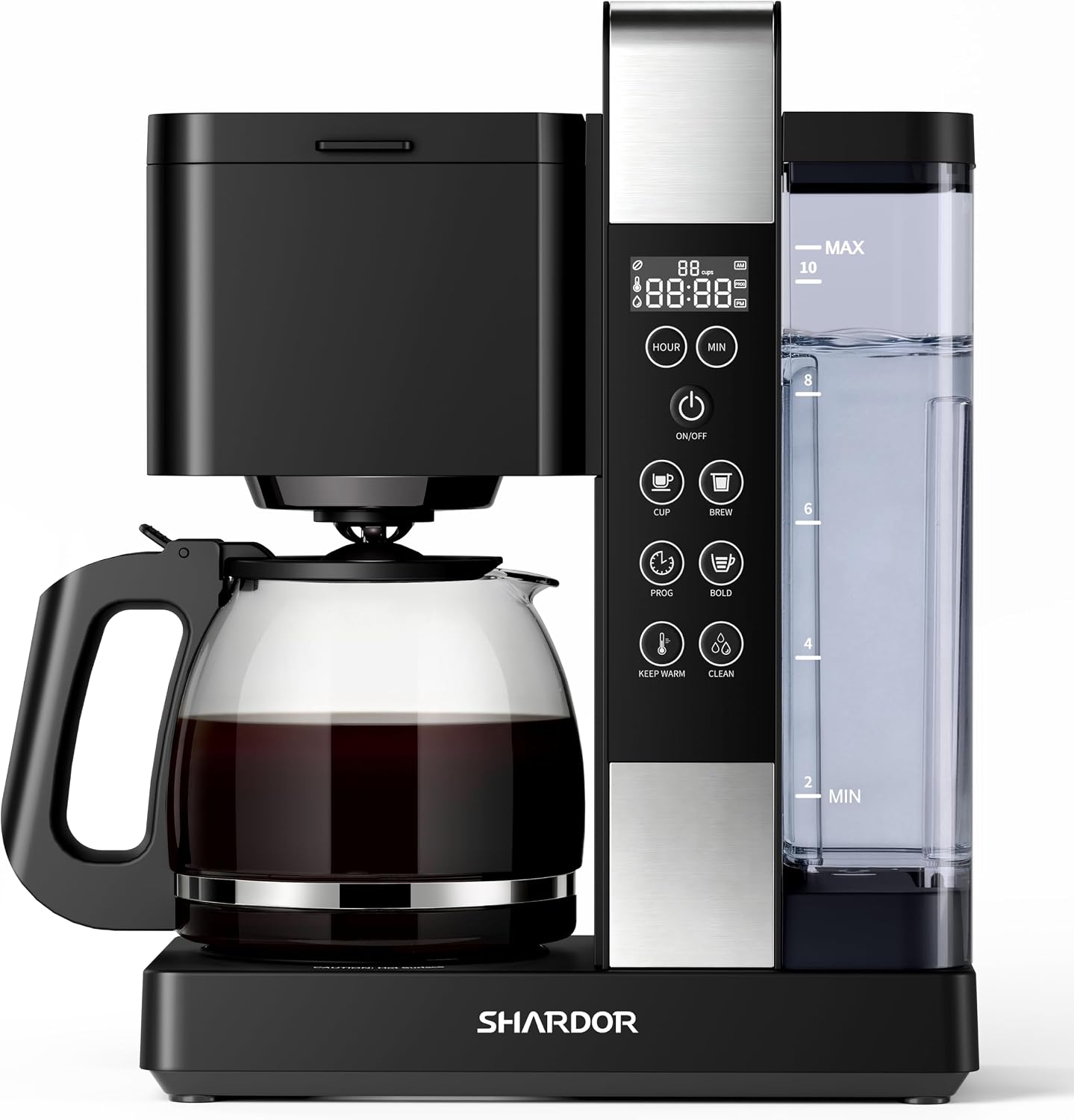
The SHARDOR 10 Cup model offers a clear LED control panel and preset memory that retains your settings even when unplugged. Its removable 50oz water tank is practical for refilling and cleaning. It lacks a thermal carafe and uses plastic parts, so it suits those valuing ease of programming over premium materials.
Brand: SHARDOR · Price when checked: $59.99 · Rating: 4.3 out of 5 (1828 ratings)
Pros
- Preset memory retains settings without power
- Removable water tank simplifies refilling
- Choice of bold or regular strength
Cons
- No thermal carafe to keep coffee hot longer
- Build uses plastic components
Best for versatile brewing: SHARDOR Dual Brew

This dual brew machine handles both K Cup pods and ground coffee with programmable features including 24-hour delay and a thermal carafe to keep coffee hot for hours. Its large 95oz water reservoir suits entertaining, but smaller single-serve capacity means it might not satisfy larger groups all at once.
Brand: SHARDOR · Price when checked: $89.98 · Rating: 4.5 out of 5 (522 ratings)
Pros
- Compatible with pods and ground coffee
- Large removable water reservoir
- Double-wall thermal carafe keeps coffee hot
Cons
- Single-serve capacity limited to 32oz
- More complex controls may overwhelm some users
Best for fast, consistent pour-over style: Bonavita BV1901TS

Bonavita focuses on delivering water at 194°–205°F (90°–96°C) with a specially designed showerhead for even extraction, brewing 8 cups in about 6 minutes. It includes a stainless steel thermal carafe and is SCA certified. It lacks programmability and a grinder, so it suits those who prioritise brewing precision over extra features.
Brand: Bonavita · Price when checked: $189.95 · Rating: 3.9 out of 5 (821 ratings)
Pros
- Powerful 1500W heater for optimal temperature range
- Special showerhead for even coffee ground saturation
- Stainless steel thermal carafe retains heat well
Cons
- No programmable timer or brew strength settings
- No built-in grinder
Best for simple eco-friendliness: SHARDOR 8 Cup

This SHARDOR model offers straightforward one-touch brewing with a reusable filter, cutting down on paper waste. It has a glass carafe and detachable parts for easy cleaning. It suits users wanting a no-frills machine but lacks timers and thermal retention, so it’s less ideal for slow sippers.
Brand: SHARDOR · Price when checked: $59.99 · Rating: 4.3 out of 5 (821 ratings)
Pros
- Reusable permanent filter reduces waste
- Glass carafe for neutral flavour
- Easy disassembly for cleaning
Cons
- No programmable settings or timer
- No thermal carafe; coffee cools quickly
Best for large capacity with vortex brewing: BLACK+DECKER 12-Cup

BLACK+DECKER’s 12-cup drip coffee maker features vortex brewing technology designed to circulate water evenly through grounds for richer flavour. Its large capacity fits families or offices, but size and lack of detailed programmable features make it less suited for smaller kitchens or those wanting precise control.
Brand: BLACK+DECKER
Pros
- Vortex brewing enhances extraction
- Large 12-cup capacity suits groups
- Simple operation
Cons
- Limited programmability details available
- Larger footprint may not fit small kitchens
Best for compact quick brews: Elite Gourmet 5-Cup

Elite Gourmet’s 5-cup drip coffee maker is compact with a reusable filter and pause-and-serve feature. Its smaller capacity is practical for single users or couples, but it lacks advanced features and thermal carafes, making it less suitable for those who want larger batches or longer heat retention.
Brand: Elite
Pros
- Compact size fits small spaces
- Reusable filter reduces waste
- Pause and serve function for immediate pouring
Cons
- Limited to 5-cup capacity
- Minimal features and no programmability
How to choose the right drip coffee maker for your morning routine
Start by identifying your typical coffee volume. If you brew daily for several people, a larger 10- to 12-cup machine with a big water reservoir will save frequent refills. Single or two-cup households might prefer compact 5- or 8-cup models to avoid stale leftovers.
Consider whether you want programmability like delay timers or brew strength adjustment. These features add convenience but can complicate operation or increase price. If you value precise temperature control and extraction, look for machines with strong heating elements and showerhead designs.
Material matters too. Thermal carafes keep coffee hot longer but add weight and cost. Glass carafes are lighter and cheaper but require a hot plate that risks overcooking coffee if left on too long. Permanent filters reduce waste and cost but need regular cleaning to avoid flavour transfer.
Finally, be realistic about your kitchen space and noise tolerance. Built-in grinders add grind-fresh flavour but generate noise and require cleaning. Plastic-free machines appeal to some but often come with a price premium. Knowing what trade-offs you are willing to make helps narrow your best options.
Related reading
- Blade vs. Burr Coffee Grinder: Why It Actually Matters for How Your Coffee Tastes
- Mixer grinder vs wet grinder: Understanding the real differences
- Red Beans and Rice Preparation: Expert Guide
Frequently Asked Questions
Is a thermal carafe worth it for morning coffee?
Thermal carafes are insulated to keep coffee hot for hours without a warming plate, which can continue to cook the coffee and cause bitterness. They are worth it if you sip coffee slowly or want to brew a batch to drink over time. However, thermal carafes add cost and weight, and some users find glass carafes with warming plates sufficient for quick consumption.
Does a built-in grinder improve coffee quality in drip machines?
Built-in grinders provide freshly ground coffee, which preserves volatile aromas and flavours that diminish with pre-ground beans. Burr grinders, especially horizontal ones, produce consistent particle sizes important for even extraction. The trade-off is added noise, cleaning needs, and complexity. If you already own a good grinder, a separate drip maker without one is fine.
How important is water temperature control in drip coffee makers?
Water temperature between 195°F and 205°F (90°C to 96°C) is crucial for extracting coffee solubles properly. Lower temperatures under-extract, yielding sour or weak coffee; higher temperatures over-extract and cause bitterness. Machines with precise thermostats and heating elements that maintain this range consistently produce a better balanced cup.
Rimi Sultana is a home cook from Bangladesh who has cooked for her family every day for the past five years and writes about it at Smart Cooks. Perpetually testing whether internet-famous recipes actually work in a regular home kitchen. Say hello on Facebook or through the contact page.