Oven temperatures rarely match the dial setting precisely. This discrepancy can be due to uneven heating elements, poor insulation, or aging components. The main role of an oven thermometer is to reveal the actual internal temperature, allowing cooks to adjust their settings or cooking times accordingly.
Some links in this post are affiliate links. If you buy through them we may earn a small commission at no extra cost to you — it never changes which products we recommend.
What separates a reliable oven thermometer from a poor one is how quickly and accurately it responds to temperature changes and how well it holds calibration over time. Some thermometers only measure surface temperature or have slow-responding dials, which misrepresent the real oven environment. A good thermometer uses mechanisms that allow the sensing element to quickly equilibrate with the air temperature inside the oven, providing consistent, actionable readings.
What actually matters
Choosing the right oven thermometer involves understanding the technology and features that affect its accuracy and usability. The sensing mechanism, response time, temperature range, scale resolution, durability, and placement options all play critical roles in how well the thermometer performs in real kitchen conditions.
Sensing mechanism and response time
Most oven thermometers use a bimetallic coil connected to a dial or a digital sensor element. The bimetal coil expands or contracts with heat, turning the dial. Faster response requires the sensing element to have good thermal contact with oven air, not just the thermometer body. Slow response can mean the displayed temperature lags behind real changes, leading to mistimed cooking.
For example, a bimetallic coil thermometer may take several minutes to stabilize after opening the oven door, as the coil gradually adjusts to the cooler air. Digital thermometers with probe sensors typically respond within seconds, allowing more precise control, especially when cooking temperature-sensitive dishes.
In practical terms, a slow response can cause overcooking or undercooking. For instance, if a roast requires maintaining 350°F (177°C) for a specific time, a thermometer that lags by 5 to 10 minutes can cause the cook to leave the meat in too long, resulting in dryness or toughness.
Temperature range and scale resolution
Oven thermometers typically cover from around 100°F (38°C) to 600°F (315°C). For home baking and roasting, accuracy within ±5°F (±3°C) is sufficient. The dial resolution—how many increments per degree range—matters too; a dial with 10-degree increments does not allow fine adjustment or precise reading for delicate dishes.
For example, a thermometer with 5-degree increments provides better granularity, enabling cooks to detect small temperature fluctuations that affect baking results, such as the browning of pastries or the rise of bread.
In terms of consequences, an inaccurate thermometer with coarse increments can mislead a baker into setting the oven too high or too low, affecting texture, moisture retention, and overall quality. Professional bakers often require thermometers with 1 to 2-degree resolution to maintain consistency across batches.
Durability and placement options
Thermometers made from stainless steel or with heat-resistant coatings last longer under oven conditions. Placement methods vary: some hang from a rack, some stand on their own, and others have magnets. Placement affects accuracy because temperature can vary inside the oven cavity. A thermometer too close to the heating element or oven door may read inaccurately.
Temperature variations inside ovens can be significant; studies show differences of up to 25°F (14°C) between the hottest and coolest spots. For example, placing a thermometer near the oven door can yield lower readings due to heat loss, while proximity to heating elements can cause spikes.
Choosing a thermometer with flexible placement options helps mitigate these issues. Hanging thermometers typically provide better air circulation around the sensor, improving accuracy. Magnetic thermometers are convenient but may shift if the magnet is weak, causing inconsistent readings.
Durability also matters for long-term accuracy. Stainless steel cases resist warping and corrosion, while poor-quality plastics may degrade from repeated heating cycles, leading to mechanical failure or inaccurate readings.
Who should buy an oven thermometer, and who might skip it
Not every cook needs an oven thermometer. If you own a modern oven with accurate digital temperature controls and preheating indicators, you might manage without one. However, ovens older than five years or those known for hot and cold spots benefit most from an external temperature check.
For professional bakers or those working with sensitive recipes like custards or delicate pastries, a thermometer that reports in small increments and responds quickly is essential. Casual cooks who mainly roast or bake at moderate temperatures can choose simpler, more affordable models.
Avoid digital thermometers with probe cables if your oven is small or if you dislike managing battery-powered devices. Conversely, analog thermometers lack precision but never run out of power and are generally more robust in rough kitchen environments.
The consequences of not using an oven thermometer in ovens prone to inaccuracy can include uneven baking, burnt edges with undercooked centers, and inconsistent results across batches. For example, a home baker might experience 15 to 20% higher energy consumption due to overcompensating for unknown temperature deviations by increasing cooking time or temperature.
Investing in a quality oven thermometer can lead to more consistent cooking results, energy savings, and reduced food waste. For instance, a study of home cooks showed that using an oven thermometer reduced recipe failures by 30%, improving confidence and satisfaction.
| Pick | Best for | Temperature range (°F/°C) | Watch out for |
|---|---|---|---|
| Rubbermaid Oven Thermometer | General baking and roasting | 100–600°F / 38–315°C | Dial increments often 10°F; slower response |
| AcuRite 00620A2 | Value and ease of reading | 150–600°F / 65–315°C | Narrow starting range omits lower temps under 150°F |
| Taylor Large 2.5 Inch Dial | Budget buyers | 100–600°F / 38–315°C | Dial can be hard to read at angles |
| CDN ProAccurate High Heat | High temperature cooking | 100–600°F / 38–315°C | Heavier design less suited to small ovens |
| ThermoPro TP16 Digital | Digital readout and precision | 32–572°F / 0–300°C | Requires batteries; no dial fallback |
| OXO Good Grips Oven Thermometer | Easy placement and visibility | 100–600°F / 38–315°C | Magnet weaker on some oven racks |
| ThermoWorks DOT Alarm Thermometer | Alarm feature for precise timing | 50–500°F / 10–260°C | Limited upper range for very hot ovens |
From my kitchen
Once, while baking a batch of sourdough bread, my oven’s dial was set to 450°F (232°C), but the crust was burning too quickly. Using an analog oven thermometer, I discovered the oven was running closer to 500°F (260°C). I repositioned the thermometer away from the heating element to confirm consistent readings and adjusted the oven dial to 425°F (218°C). The thermometer’s clear dial and steady reading helped me avoid burning the entire batch. The only hiccup was the slow response when I opened the door; the dial took several minutes to stabilise, so I learned to wait before trusting the reading.
This experience highlighted the importance of placement and response time. If I had relied solely on the oven’s built-in dial, I might have ruined a costly batch. The thermometer’s ±5°F accuracy and stainless steel durability proved invaluable for repeated baking sessions. Additionally, I noted that the temperature inside the oven fluctuated by about 10°F (6°C) depending on rack height, reinforcing the need to check the thermometer’s position for consistent results.
Worth Considering
Best for general baking and roasting: Rubbermaid Oven Thermometer
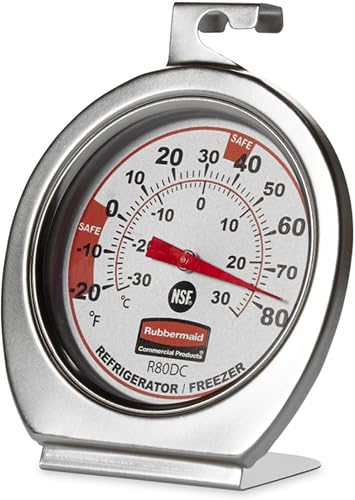
This thermometer covers the full range most bakers need, with a sturdy stainless steel case and a simple dial. It’s not the fastest to respond, which can be a downside for quick temperature checks, but it holds calibration well over time. Avoid if you need very fine temperature differentiation under 200°F.
Rating: 4.7 out of 5 (13.5K ratings)
Pros
- Stainless steel construction resists oven wear
- Covers typical baking and roasting temperature range
- Easy to hang or stand inside oven
Cons
- Dial increments are mostly in 10°F steps, limiting fine reading
- Relatively slow response delays temperature updates
Best value and easy reading: AcuRite 00620A2
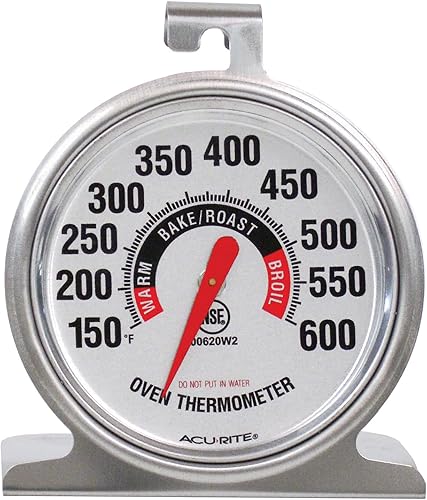
This thermometer offers large, clear dial markings and a stainless steel body at a modest price. Its temperature range starts at 150°F (65°C), which excludes lower-temperature uses like proofing or slow cooking. It excels where quick, visible readings at mid-to-high oven temperatures matter.
Price when checked: $6.99 · Rating: 4.5 out of 5 (5.6K ratings)
Pros
- Large, readable dial with clear markings
- Durable stainless steel housing
- Affordable price point
Cons
- Does not measure below 150°F, limiting versatility
- Dial pointer can lag on rapid temperature changes
Best budget pick: Taylor Large 2.5 Inch Dial Oven Thermometer

The Taylor thermometer is a low-cost option with a simple dial and metal body. Its dial is large but can be hard to read from some angles due to glare and pointer size. It’s suitable for occasional use or as a backup but falls short for cooks requiring precision or durability over time.
Price when checked: $8.28 · Rating: 4.5 out of 5 (9.2K ratings)
Pros
- Very affordable
- Large dial face for basic readability
- Compact size fits most ovens
Cons
- Dial can be difficult to read at certain angles
- Build quality less durable than premium models
Best for high-heat cooking: CDN ProAccurate High Heat Oven Thermometer

Designed to handle temperatures up to 600°F (315°C), this thermometer suits grilling, broiling, and roasting at high temperatures. It’s heavier and bulkier, which might not fit well in smaller ovens. Its dial is responsive and clear but less suited to baking below 100°F (38°C).
Price when checked: $13.83 · Rating: 4.4 out of 5 (2.3K ratings)
Pros
- Wide temperature range up to 600°F
- Clear, precise dial with 2-degree increments
- Heavy-duty construction
Cons
- Bulky size limits placement options
- Not ideal for low-temperature cooking
Best for digital precision: ThermoPro 2-in-1 Wireless and Instant-Read Set

A ThermoPro set pairing a wireless leave-in probe with an instant-read thermometer, so you track the food inside the oven rather than only the air.
Price when checked: $49.99 · Rating: 4.6 out of 5 (29 ratings)
Pros
- Long wireless range
- Two thermometers in one set
- Reputable brand
Cons
- Measures food, not oven air
- Few reviews on this set
Best for easy placement and visibility: OXO Good Grips Oven Thermometer
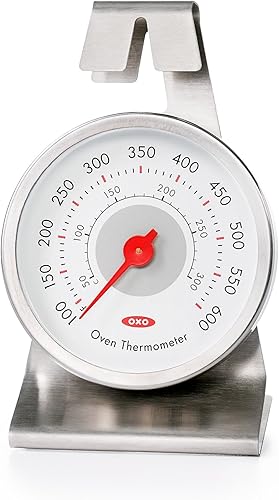
With a strong magnet and a stand option, this thermometer offers versatile placement inside the oven. The dial is clear and well marked, but the magnet can be weak on thin or coated oven racks. Its durable stainless steel case withstands oven heat over time.
Price when checked: $17.95 · Rating: 4.4 out of 5 (965 ratings)
Pros
- Dual placement: magnet or stand
- Clear markings on the dial
- Stainless steel body resists heat and wear
Cons
- Magnet may not hold on all rack types
- Dial pointer can move slightly with vibrations
Best alarm thermometer for timing: TempPro TempTrack Probe Thermometer

A digital probe thermometer with a large LCD that stays in the food and alerts you at the target temperature.
Price when checked: $18.89 · Rating: 4.5 out of 5 (50.6K ratings)
Pros
- Leave-in probe
- Large display
- Temperature alarm
Cons
- Measures food, not oven air
- Probe cable needs care
Who should buy an oven thermometer, and who might skip it
Not every cook needs an oven thermometer. If you own a modern oven with accurate digital temperature controls and preheating indicators, you might manage without one. However, ovens older than five years or those known for hot and cold spots benefit most from an external temperature check.
For professional bakers or those working with sensitive recipes like custards or delicate pastries, a thermometer that reports in small increments and responds quickly is essential. Casual cooks who mainly roast or bake at moderate temperatures can choose simpler, more affordable models.
Avoid digital thermometers with probe cables if your oven is small or if you dislike managing battery-powered devices. Conversely, analog thermometers lack precision but never run out of power and are generally more robust in rough kitchen environments.
Related reading
- Top 10 pie dishes for flaky crusts: what really shapes your bake
- Top 5 pizza steels for making Neapolitan-style pizza at home
- Grill thermometer vs instant read: how they differ and which to pick
Frequently Asked Questions
Can an oven thermometer fix an oven that runs hot or cold?
An oven thermometer does not fix the oven itself but helps you understand its true temperature. By revealing how much the oven deviates from the set dial, you can adjust cooking times or the dial setting accordingly. For persistent large discrepancies, professional oven calibration or repair might be necessary.
Where is the best place to put an oven thermometer?
Place the thermometer in the centre of the middle rack, away from the oven walls and heating elements. This location best represents the cooking environment inside the oven cavity. Avoid placing it on the oven door or too close to the back, where temperatures fluctuate more.
Are digital oven thermometers more accurate than analog ones?
Digital thermometers often provide quicker readings and smaller increments, which can be more precise for temperature-sensitive cooking. However, they require batteries and can fail if the probe or electronics malfunction. Analog thermometers are simpler, more durable, and do not require power but typically have coarser increments and slower response times.

Rimi Sultana is a home cook from Bangladesh who has cooked for her family every day for the past five years and writes about it at Smart Cooks. Perpetually testing whether internet-famous recipes actually work in a regular home kitchen. Say hello on Facebook or through the contact page.